For many women, stubborn fat around the hips and thighs can feel impossible to get rid of no matter how hard you work out.
The good news? This is not necessarily a sign that you’re doing something wrong.
Here’s why your thigh fats are sticking around, and what you should do.
You may have heard the idea that you can “target” fat loss in a specific area—like doing endless squats to slim your thighs. Sadly, this is false.
Studies show that the body doesn’t selectively burn fat in one area over another. Instead, fat loss happens more generally across the body as you create a calorie deficit.
A study by the National Library of Medicine showed that one’s genes determine up to 60% of fat distribution in the body.
Fat distribution is largely influenced by gender (National Library of Medicine). Women generally have a higher percentage of body fat compared to men and lose less fat from their leg fat stores relative to men. After meals, men tend to store fat in the visceral (deep belly) area, while women store fat in subcutaneous fat—fats under the skin, which are heavily concentrated in the hips, thighs, and buttocks.
Women’s lower-body fat is generally more stable and slower to break down compared to men, likely because hormones like estrogen help the body store energy for pregnancy.
Fat in different body areas reacts differently to hormones (National Library of Medicine). Belly fat contains more of one type of estrogen receptor (ERα), while thigh fat has more Erβ receptors. The balance between these receptors is linked to fat distribution. Women with more belly fat tend to have less ERβ in their thigh fat. This hormone balance, along with genetics, helps explain why some women hold onto thigh fat more stubbornly than others—even with similar diets and workouts.
While you can’t control where your body loses fat first, you can take a more informed approach to keep track of your progress.
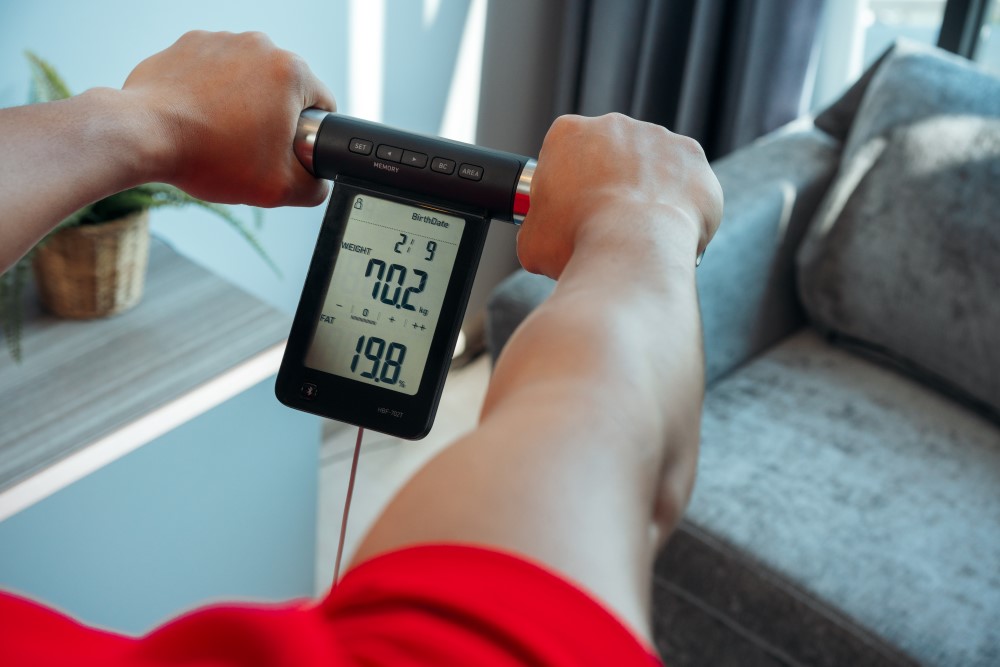
Rather than relying on a standard weighing scale, consider using a body composition monitor which provides deeper insights into changes in body fat, muscle mass, and overall body composition over time.

This compact and minimalist 2-point body composition monitor is perfect for anyone looking to understand their body beyond just weight.
It provides you with detailed insights into weight, body fat percentage and mass, skeletal muscle percentage and mass, visceral fat level, resting metabolism, body age, and BMI.
With Bluetooth connectivity, you no longer need to track your measurements on paper—your data is automatically synced and can be conveniently accessed through the OMRON connect app.

This 4-point body composition monitor uses four electrodes to measure impedance across the entire body, offering an extensive analysis of your body composition.
It measures body weight, BMI, body fat percentage, segmental subcutaneous fat percentage (whole body, trunk, legs, and arms), segmental skeletal muscle percentage, resting metabolism, body age, and visceral fat level. You can enter your age and height, and the device will show how you compare to the average in each category.
Equipped with Bluetooth connectivity, you can seamlessly sync your readings to the OMRON connect app and access your data anytime, anywhere.
Remember: stubborn thigh fat isn’t a failure—it’s biology.
By tracking your body composition over time, you can celebrate the progress you are making, even when certain areas take a little longer to change.
Knowledge is power, and small wins add up.
|
Previous article Rethinking Health: Why Weight Isn't Everything |
Next article |