




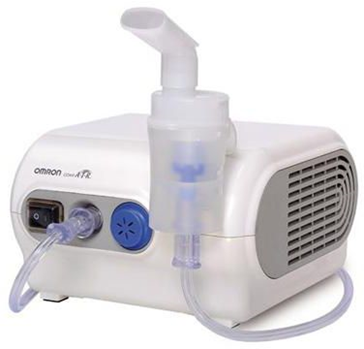
Compressor Nebulizer NE-C101
Omron NE-C101 makes managing your respiratory health easy. It's simple to use, efficient, ensuring quick and reliable treatment for you and your loved ones.
 0 (0 Review)

Easy to clean and maintain
Compressor (Main Unit), Nebulizer Kit, Mouthpiece, Nosepiece, Adult Mask (PVC), Child Mask (PVC), Air Tube (PVC, 100cm), Spare Air Filters x 2, Instruction Manual, Quick Start Guide, Warranty Card
- Nebulizer Type Compressor
- Approximate Nebulization Rate (ml/min) 0.3ml/min
- Approximate Particle Size (micro meter MMAD) 3.9µm
- Max Medication Capacity 12 ml
- Noise level <63dB
- Aerosol Output (ml) 0.259
- Aerosol Output Rate (ml/min) 0.05
- Weight in (kg) 1.05
- Approximate Dimensions (mm) 145 (W) x 124 (H) x 183 (D)
- Suitable for Home
The size and the noise level of the nebulizers are dependent on the technology it was developed with. According to the European Respiratory Society (ERS) guidelines4, particle size, aerosol output and aerosol output rate are the key performance indicators.
#2 The More Mist Produced, The More Effective The Treatment.
Visibility of the aerosol produced is dependent on the particle size. Higher mist visibility suggests larger particle size, which is suitable for upper airway treatment. Whereas, most asthma medication targets the lower airways. Look for nebulizers that produce the right sized particles (MMAD) for the most effective treatment.
#3 One Nebulizer Can Treat Both Airways
Not every nebulizer comes with the capability to target both airways. Some nebulizer models have the added feature to adjust the particle size produced. Select your nebulizer based on your target treatment area.
A nebulizer is a drug delivery machine which converts liquid medicine into aerosol droplets that can easily be inhaled through a mouthpiece or mask.
Nebulizers are primarily used in the treatment of asthma, COPD, and other breathing problems. However, it is also used for severe cases of nasal and chest congestion as it provides immediate relief by the opening of airways.
Reference: Boe J et al (2001). European Respiratory Society Guidelines on the use of nebulizers. Eur Respir J. 18(1):228-42.
Click here to find out more about Omron’s nebulizers.
A nebulizer can be used in the treatment of 1) middle & lower respiratory conditions, as well as 2) upper airway conditions.
Examples of such conditions include
Middle & Lower Airways:
- Asthma
- Chronic Obstructive Pulmonary Disease (COPD)
- Bronchitis & Bronchiolitis Pneumonia
Upper Airways:
- Cough & cold
- Common flu
- Blocked nose
The suitability of the nebulizer in treating the different conditions depends on the particle sizes produced by the nebulizer (median mass aerodynamic diameter or MMAD), as well as the accessories that come with the nebulizer.
- Delivers medication directly to where it is needed.
- Direct action of the drug on the target organ.
- Immediate effect after inhalation.
- Same effects as oral medication, but with lower dosage.
- Minimisation of possible systemic adverse effect risks.
- Patients can inhale medication with no coordination1 needed.
- Possible to mix different medications from prescription2.
- Some devices can be used for treating upper and lower airway diseases with one device.
Reference: (1) Laube BL et al (2011). What a pulmonologist should know about the new inhalation therapies. Eur Respir J. 37(6):1308-31. (2) Gardenshire D et al (2013). A guide to aerosol therapy for respiratory therapists - 3rd ed. American Association for Respiratory Care , p. 10.
Distilled water or purified water cannot be used alone as a drug solution for nebulization.
Different Types Of Nebulizers for various uses
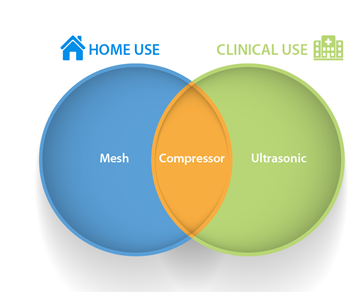
Compressor Nebulizer
Benefits
- Easy to use, also suitable for children
- Almost all types of medication is supported
- Very reliable
- Cost-effective
Disadvantages
- Bulky
- Cleaning of many parts
- Can be noisy
- Require power outlet
2. Mesh Nebulizers
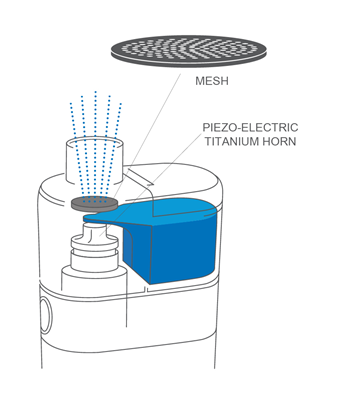
Benefits
- Portable
- Silent
- Operates at all angles
- Simple one-button operation
Disadvantages
- Relative high costs
- Thorough cleaning is required, especially the mesh element
3. Ultrasonic Nebulizers
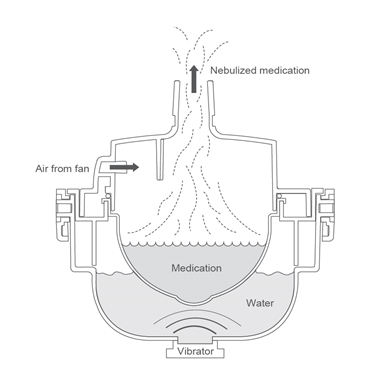
Benefits
- Quiet and easy operation
- High output (‘nebulization rate’) ~ up to 10 times as compared to Compressor Nebulizer
Disadvantages
- More expensive than a Compressor Nebulizer
- Not possible to nebulize suspensions (e.g. Pulmicort) and medications with higher viscosity
- Some medications (e.g. antibiotics), may change in quality, due to high ultrasonic energy
- Requires AC power
- In addition to the medication, water is required for cooling
0.0 rating
0 reviews