







Reduce stroke risk by 68% with early detection of AFib1
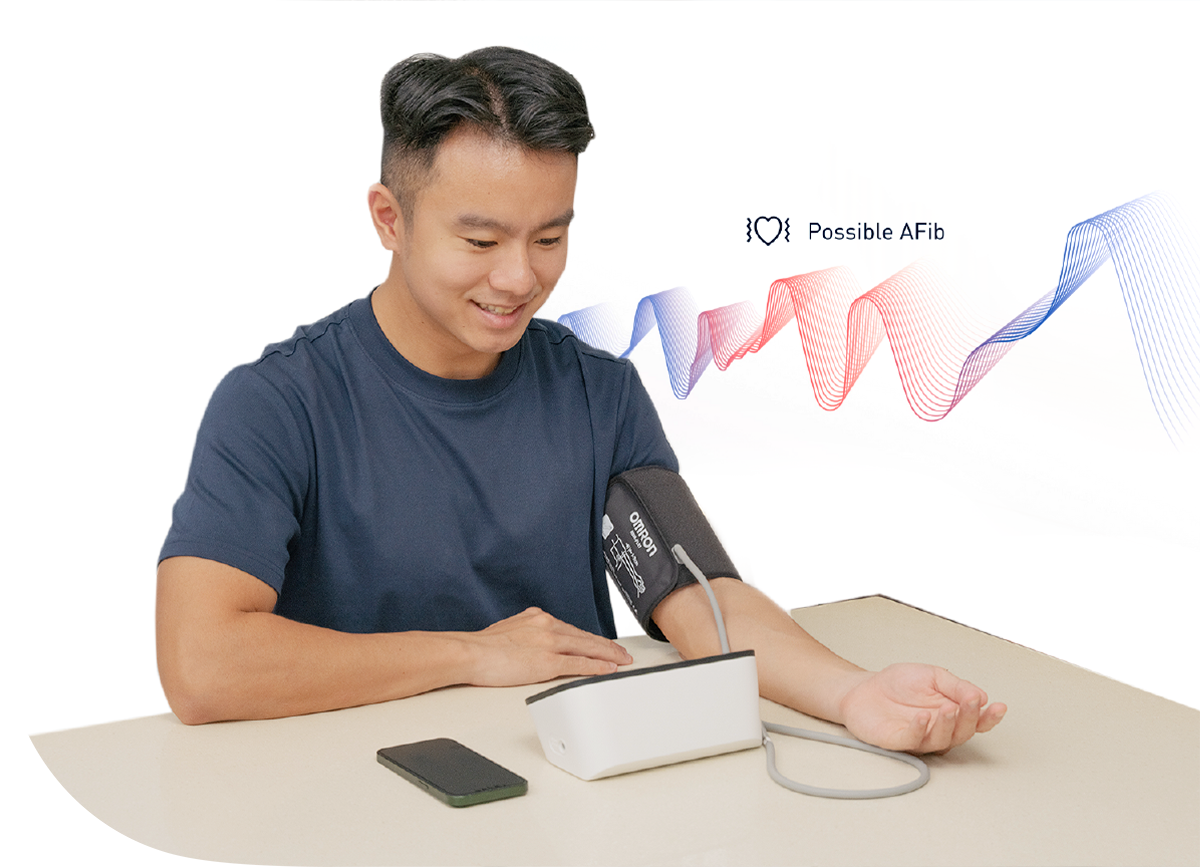
AFib is a heart rhythm disorder characterized by rapid and irregular heartbeats2
A normal resting heart rate is 60-100 beats per minute.3 In contrast, those with AFib experience irregular and rapid heartbeats of more than 400 times per minute.4 This elevates stroke risk by five times, accounting for 20%-30% of all strokes.5


AFIB BY THE NUMBERS 6
Million people are affected by AFib
AFib increases risk of stroke by
High blood pressure is found in
AFib cases
Early detection of AFib reduces risk of stroke
But AFib can also strike without symptoms and slip under the radar during routine check ups. That's why regular home screening is vital.
Screen for AFib Early - From the Comfort of Home
With OMRON's Intellisense TM AFib and home ECG recording, you can screen for the possibility of atrial fibrillation (AFib) and track your heart rhythm easily at home. This helps reduce the risk of stroke and heart failure, and supports better-informed conversations with your healthcare provider.
Routine blood pressure checks now automatically screen for Atrial Fibrillation with the revolutionary Intellisense AFib technology.
Maximize the benefits of regular monitoring


Dual function
With a touch of a button, automatically screen for AFib every time you measure your blood pressure.

No extra step needed
Eliminate the need for multiple health gadgets enabling a single-step at-home screening that goes beyond doctor visits.

Accurate AFib screening
Our Intellisense AFib technology is clinically validated, delivering 97% overall accuracy with 95% sensitivity and 98% specificity.

Know when to seek help
Our Intellisense AFib technology is clinically validated, delivering 97% overall accuracy with 95% sensitivity and 98% specificity.

OMRON's AI-powered technology calculates blood pressure values and detects AFib using a pulse pressure wave (PPW). A PPW is a waveform that represents arterial pressure changes. Intellisense AFib captures these differences to detect the possibility of AFib.
Normal PPW

AFib

Intellisense AFib vs ECG technology

Intellisense AFib technology enables more and more people to access convenient, effective methods of detecting Atrial Fibrillation early to aid in safe guarding their heart health.
While ECG is a different technology providing healthcare professionals with more detailed cardiac data from regular monitoring in order to inform the diagnostic process, facilitate evaluation of medication effectiveness and aid in preventing recurrence of events.
Check your blood pressure and AFib in one go
Quick blood pressure check now automatically reveals AFib risks


![Automatic Blood Pressure Monitor IQ BT Power [HEM-7194T1-FLC]](https://www.omronhealthcare-ap.com/Content/uploads/products/876299f45eaa4e96966af701f9799434.png)

![Automatic Blood Pressure Monitor IQ Power [HEM-7193-FLC]](https://www.omronhealthcare-ap.com/Content/uploads/products/12eb4ca5c1164fb8a7b539d0fea51bd1.png)
![Automatic Blood Pressure Monitor IQ BT [HEM-7194T1-FL]](https://www.omronhealthcare-ap.com/Content/uploads/products/8e9c33210f014ae680d93eeb46659fbb.png)
![Automatic Blood Pressure Monitor IQ [HEM-7193-FL]](https://www.omronhealthcare-ap.com/Content/uploads/products/0d9030027a0b422b81a620d04fc67afc.png)
Clinically validated blood pressure monitors with the revolutionary Intellisense AFib technology



Reference:
1. Howard, Patricia A. “Guidelines for stroke prevention in patients with atrial fibrillation.” Drugs 58.6 (1999): 997-1009.
2. Mayo Clinic Staff. (2026, January 14). Atrial fibrillation - Symptoms and causes. Mayo Clinic. https://www.mayoclinic.org/diseases-conditions/atrial-fibrillation/symptoms-causes/syc-20350624
3. NHS. (2025, January 13). Atrial fibrillation. National Health Service. https://www.nhs.uk/conditions/atrial-fibrillation/
4. Johns Hopkins Medicine. (n.d.). Atrial fibrillation. Johns Hopkins Medicine. Retrieved June 10, 2026, from https://www.hopkinsmedicine.org/health/conditions-and-diseases/atrial-fibrillation
5. Di Carlo, A., Bellino, L., Consoli, D., Mori, F., Zaninelli, A., Baldereschi, M., Cattarinussi, A., D’Alfonso, M. G., Gradia, C., Sgherzi, B., & FAI Project Investigators. (2019). Prevalence of atrial fibrillation in the Italian elderly population and projections from 2020 to 2060 for Italy and the European Union: The FAI Project. EP Europace, 21(10), 1468–1475. https://doi.org/10.1093/europace/euz141
6i. Ruff, C. T., Giugliano, R. P., Braunwald, E., Hoffman, E. B., Deenadayalu, N., Ezekowitz, M. D., Camm, A. J., Weitz, J. I., Lewis, B. S., Parkhomenko, A., Yamashita, T., & Antman, E. M. (2014). Comparison of the efficacy and safety of new oral anticoagulants with warfarin in patients with atrial fibrillation: a meta-analysis of randomised trials. Lancet (London, England), 383(9921), 955–962. https://doi.org/10.1016/S0140-6736(13)62343-0
6ii. Morillo, C. A., Banerjee, A., Perel, P., Wood, D., & Jouven, X. (2017). Atrial fibrillation: the current epidemic. Journal of geriatric cardiology : JGC, 14(3), 195–203. https://doi.org/10.11909/j.issn.1671-5411.2017.03.011
6iii. NHS. (2025, January 13). Atrial fibrillation. National Health Service. Retrieved June 10, 2026, from https://www.nhs.uk/conditions/atrial-fibrillation/
6iv. Camm, A. J., Savelieva, I., Bharati, S., Lindsay, B. D., Nattel, S., Shinagawaa, K., & Chen, S.-A. (2005). Atrial tachycardia, flutter, and fibrillation. In S. Saksena, A. J. Camm, P. A. Boyden, P. Dorian, & N. Goldschlager (Eds.), Electrophysiological disorders of the heart (pp. 283–cp1). Churchill Livingstone. https://doi.org/10.1016/B978-0-443-06570-5.50021-6